
 EN
EN
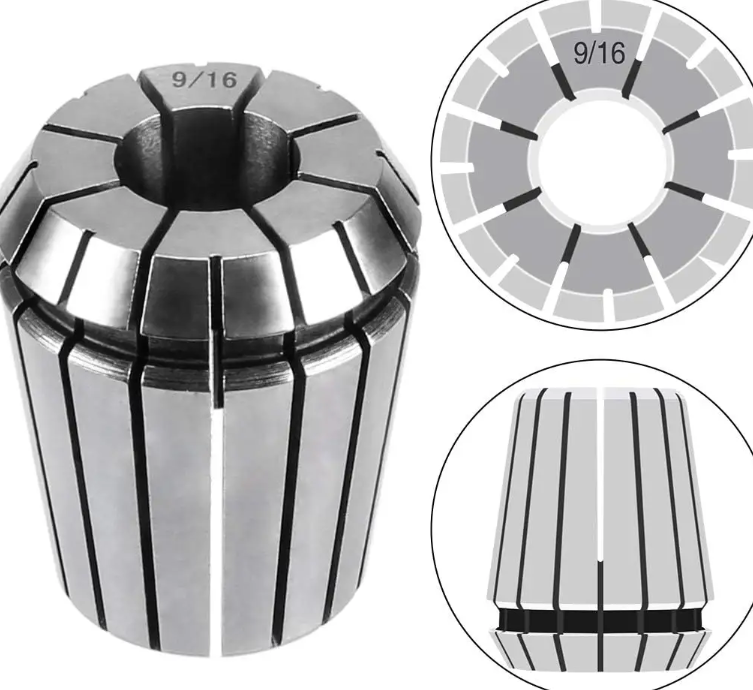
Understanding ER Collet Sizing Standards and Clamping Range
ER-11 to ER-50: Metric vs. Imperial Shank Compatibility and DIN 6499 Compliance
ER collets follow DIN 6499 standards, which set the rules for how these popular tool holders should measure up when it comes to size, tolerance levels, and overall performance. When manufacturers stick to this standard, they get reliable clamping accuracy all the way from ER-11 right up to ER-50 sizes. What many people misunderstand is that the number in the ER designation actually refers to the maximum opening space inside the collet, not the actual shaft diameter being held. Take ER-32 as an example it can open up to 32mm wide. Even though DIN 6499 uses metric measurements, most ER collets work just fine with both metric and imperial tools thanks to their flexible design that allows them to stretch slightly while maintaining grip strength.
DIN 6499 defines two precision grades:
| Precision Grade | Max Runout (mm) | Clamping Range (mm) |
|---|---|---|
| Standard | ≤0.001 | 0.5–2 undersize |
| High Precision | ≤0.0004 | 0.5–2 undersize |
All ER collets—regardless of grade—clamp tools 0.5–2 mm smaller than their nominal opening. For instance, an ER-32 collet reliably secures a 30–31.5 mm shank. This controlled collapse generates uniform radial pressure, maximizing grip without exceeding the material’s elastic limit.
Optimizing Grip Security: The 0.5–2 mm Undersize Rule for High-RPM Milling
The 0.5 to 2 mm undersize guideline isn't just made up out of nowhere. It actually represents what engineers call the elastic range where parts can clamp securely without compromising their structural strength. When we go below 0.5 mm, the contact surface gets too small which means less grip and way more runout problems sometimes as much as 40% increase. On the flip side, going over 2 mm creates all sorts of issues because the material starts to deform too much, risking permanent damage or even breaking apart when spinning really fast. At those high RPM levels above 15,000, even tiny amounts of runout turn into major vibrations that wear down tools faster than normal. Collets that follow DIN 6499 standards have these nice precision ground tapers and they're treated properly during manufacturing so the clamping force spreads out better across the workpiece. This makes for smoother operation with about half the chatter compared to cheaper alternatives that don't meet these specs.
Matching ER Collets to Spindle Tapers (BT, ISO, CAT, HSK, SK)
How Taper Geometry and Flange Design Affect ER Collet Holder Rigidity and Runout
The shape of spindle tapers plays a major role in determining how rigid ER collet holders are and how much they wobble during operation. There are basically three things at play here: how much surface area is touching, the actual angle of the taper itself, and the design of the flange around it. Take HSK systems for instance. These use a 1 to 10 taper ratio combined with both taper and face contact, which gives them about 15 percent more surface contact compared to older 7:24 tapers found in BT, CAT, and ISO systems. The extra contact spreads out the clamping force better so the holder doesn't bend as much when cutting tough materials. When it comes to flanges, different designs behave differently. V-flange CAT holders tend to handle side loads better because of their balanced structure, whereas BT spindles rely on threads to keep things secure along the axis. A big problem happens when people mix and match tapers incorrectly, like putting a BT-40 holder into a BT-50 spindle. This mismatch can actually double radial errors since parts don't fit together properly. Machines with dual contact interfaces such as HSK generally maintain runout below 3 microns, while single angle systems usually end up between 5 and 8 microns even when everything else is the same.
Runout Variation Explained: Why Identical ER Collets Perform Differently on HSK-63 vs. BT-40
When looking at identical ER collets, their runout can vary significantly based on the spindle interface they're used with. Some tests show runout can be as much as 60% greater in BT-40 systems compared to HSK-63 when operating at around 15,000 RPM. Why does this happen? Well, it all comes down to how these tapers react to those pesky centrifugal and thermal forces we always deal with in machining. The HSK design with its hollow shank and dual contact points keeps that spindle to holder pressure pretty steady across different speeds, which limits any radial movement to less than 5 microns. On the flip side, BT-40's single taper starts showing noticeable elastic deformation once it hits about 8,000 RPM, letting the tool wobble between 10 and 15 microns. Thermal expansion matters too. The steel alloy used in HSK spindles grows about 30% less than the standard carbide mixtures found in BT systems, so the collet stays compressed and centered even after long periods of heavy cutting. For shops doing precision finishing work or running high speed contouring operations, HSK-63 really shines by keeping ER collets within their best performing elastic range. Meanwhile, BT-40 still has its place for everyday jobs where RPMs aren't pushing those extreme limits.
Integrating ER Collets with Modern Tool Holding Systems
Hydraulic, Shrink Fit, and Milling Chucks: Mechanical Interface Requirements for ER Collets
Modern high-performance machining requires careful integration of ER collets with advanced tool holding systems—each imposing distinct mechanical demands on the collet interface.
- Hydraulic chucks rely on fluid pressure to compress the collet sleeve. ER collets must feature a precisely ground 8° taper (±0.01° tolerance) to maintain ≤5 μm runout under hydraulic loading. Excessive radial force can distort slot geometry—reinforced collet designs are recommended for sustained operation above 15,000 RPM.
- Shrink fit systems demand thermal stability: ER collets require heat-treated steel (HRC 58–62) to survive repeated 300°C induction cycles without distortion. Crucially, the collet’s thermal expansion coefficient must closely match that of the holder to ensure <3 μm concentricity at 3xD depth after cooling.
- Milling chucks, engineered for rigidity in aggressive metal removal, use hardened flanges and axial preload springs to suppress vibration. Their ER interfaces sacrifice clamping flexibility for security—halving the usable range to ~0.3 mm (vs. the standard 0.5 mm) to maximize radial engagement during heavy slotting or ramping.
| Holding System | Critical ER Interface Requirement | Performance Impact |
|---|---|---|
| Hydraulic | Taper angle tolerance ±0.01° | Runout increases 200% if exceeded |
| Shrink Fit | Thermal expansion coefficient match | Prevents micro-slip during thermal cycling |
| Milling | Flange thickness ≥ 12% collet diameter | Reduces chatter amplitude by 40% (DIN 6499) |
Proper alignment between ER collet specifications and holder requirements extends tool life significantly—studies show matched systems reduce vibration-induced insert failures by 60% in high-feed milling. Always adhere to manufacturer-specified torque values; overtightening degrades clamping efficiency by up to 35%, regardless of holder type.