
 EN
EN
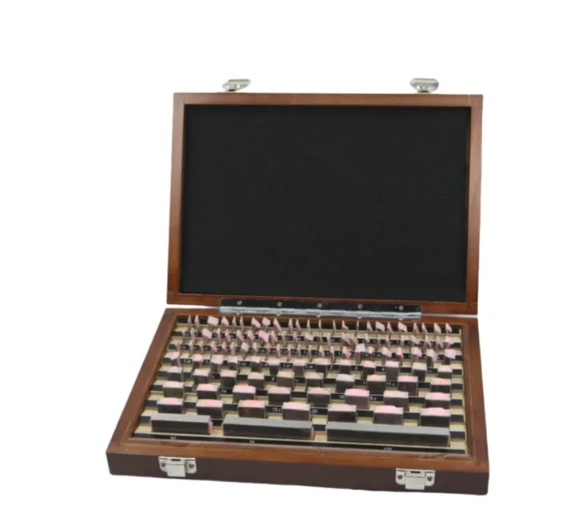
Environmental and Handling Risks to Gauge Block Accuracy
Thermal expansion and humidity-induced dimensional drift in steel gauge blocks
Steel gauge blocks react strongly to changes in their environment. Just a single degree Celsius temperature shift can cause around 11.5 micrometers per meter of linear expansion, which is enough to push measurements beyond acceptable limits for high precision Class 0 or AA applications. When humidity levels rise above 40% relative humidity, water molecules start sticking to those polished surfaces, leading to noticeable dimensional changes of about half a micrometer over time. To keep calibrations trustworthy, workshops need to maintain strict environmental controls according to ISO standards. That means keeping temperatures stable within plus or minus 0.5 degrees Celsius and controlling humidity fluctuations to within 5 percentage points. These requirements aren't just numbers on paper they represent the difference between accurate measurements and costly errors in manufacturing processes.
Skin oils, fingerprints, and particulate contamination compromising surface flatness and wringability
When someone touches a part directly, it actually creates several problems for maintaining surface quality. Fingerprints leave behind residue that makes surfaces rougher by about 0.05 to 0.1 micrometers and forms those annoying hydrophobic films which really mess with how parts stick together during wringing. Even tiny particles measuring around 5 micrometers can prevent proper contact between surfaces, leading to failed wringing attempts in approximately 15 out of every 100 cases in manufacturing settings. The dirt doesn't just stop there either. Contaminants create these strange light patterns on the contact area that go beyond 0.3 micrometers, which ends up making measurements inconsistent and throws off the actual geometry of what's being measured. This kind of thing matters a lot in precision work where accuracy counts.
Proper Cleaning Protocols for Gauge Block Surface Integrity
NIST SP 960-12–validated solvent cleaning sequence for precision steel gauge blocks
Contaminants can really mess with both the dimensional accuracy and the ability to wring surfaces properly. According to the NIST SP 960-12 guidelines, there's a two step cleaning approach recommended for dealing with these issues. First up are non polar solvents such as hexane or those isoparaffinic hydrocarbons that work great at dissolving organic stuff left behind from things like skin oils. Then comes the second stage where polar solvents like isopropyl alcohol tackle the ionic contaminants along with any remaining moisture. If done right, using lint free wipes and making sure all strokes go in one direction, this cleaning process cuts down on measurement uncertainty somewhere around 0.02 micrometers according to NIST research from 2023, while still keeping the surface finish intact and undamaged.
Wringability testing as a functional verification of cleanliness and flatness
The ability to wring surfaces together quickly tells us a lot about how clean they are and whether their shape is right. When we see successful wringing, what we're really looking at is even sticking when gentle pressure is applied, along with those telltale rainbow-like patterns that form across the surface. This means the surface is pretty much flat within about 0.1 micrometers and free from anything that might get in the way. If the wringing doesn't work out, that usually points to leftover dirt on the surface or some kind of hidden damage beneath it all, which means going back to clean again or doing some repairs. Research published in the Journal of Metrology back in 2022 found that parts which consistently pass these wringing tests tend to stay calibrated properly over time about 98% of the cases, making this simple test surprisingly valuable for quality control purposes.
Rust Prevention and Long-Term Storage Best Practices for Gauge Blocks
VCI paper versus mineral oil: Performance comparison under ISO 4937:2022 for steel gauge blocks
Long-term storage demands corrosion protection that preserves dimensional stability without introducing post-storage variables. Under ISO 4937:2022 test conditions, Volatile Corrosion Inhibitor (VCI) paper and mineral oil demonstrate complementary strengths:
- VCI paper forms an invisible, residue-free molecular barrier ideal for frequently accessed or time-sensitive applications–blocks are ready for use immediately after removal.
- Mineral oil provides robust physical coverage suited for infrequently used blocks in less-controlled environments, though it mandates full solvent cleaning before calibration or measurement.
- Both methods perform significantly better below 40% RH; humidity control remains essential regardless of inhibitor choice.
ISO 4937:2022 validation confirms VCI paper delivers superior resistance to salt spray and cyclic corrosion over extended periods (>24 months), making it preferred for certified reference sets. Mineral oil retains advantages where environmental monitoring is limited or access intervals are unpredictable.
Calibration Interval Management and Traceability Assurance
Keeping gauge blocks in good working order really comes down to smart calibration planning and maintaining proper traceability records. The old method of just sticking to fixed calendar dates doesn't cut it anymore. How often these tools need checking actually varies quite a bit depending on how much they get used, what kind of environment they're exposed to day to day (think temperature changes, how frequently someone handles them), plus looking back at past calibration results. Most blocks that see heavy action on factory floors usually need a fresh calibration somewhere between three to six months apart. Blocks sitting in controlled lab environments might last closer to twelve months before needing attention, but only if their performance history shows they can handle the longer interval without issues.
Traceability anchors all measurements to SI units through documented, unbroken chains of comparisons to accredited reference standards–ideally certified to ISO/IEC 17025. This requires:
- Comprehensive record-keeping of calibration dates, results, expanded uncertainty, and environmental conditions at time of measurement
- Verification that all reference standards carry current NIST-traceable certificates with valid accreditation
- Integration of automated calibration management systems to monitor due dates, flag deviations, and generate audit-ready reports
Without traceability–even flawlessly cleaned, stored, and handled gauge blocks lose metrological authority. In regulated sectors like aerospace or medical device manufacturing, this gap can trigger nonconformances, failed audits, or rejected inspection data.
FAQ Section
How does temperature affect steel gauge blocks?
A single degree Celsius temperature increase can lead to 11.5 micrometers per meter of linear expansion in steel gauge blocks, potentially exceeding acceptable measurement limits for precision applications.
Why is it important to control humidity around gauge blocks?
Humidity above 40% RH leads to water molecules sticking to gauge blocks, causing dimensional changes. Maintaining strict humidity levels ensures accurate measurements.
What is the recommended cleaning process for gauge blocks?
The NIST SP 960-12 guidelines recommend a two-step solvent cleaning process using non-polar and polar solvents to remove contaminants without damaging the surface finish.
How often should gauge blocks be calibrated?
Calibration intervals depend on usage and environmental exposure. Blocks used frequently should be calibrated every three to six months, while those in controlled labs may require calibration annually if performance history supports it.